AI vs ML vs DL
Detailed study notes on Artificial Intelligence, Machine Learning, and Deep Learning — how the three fields relate, why Symbolic AI failed on real-world problems, and how Deep Learning solved Machine Learning's biggest bottleneck.
1. The AI / ML / DL Hierarchy
A common technical interview question asks candidates to differentiate between Artificial Intelligence (AI), Machine Learning (ML), and Deep Learning (DL). Visually, these three fields form a nested set of concentric circles.
- Artificial Intelligence (AI): The outermost umbrella covering any system that demonstrates human-like intelligence.
- Machine Learning (ML): A specific subset within AI focused on learning rules and patterns directly from data.
- Deep Learning (DL): A specialized subset within ML that uses multi-layer artificial neural networks to learn representations from complex data.
Tip: Think of it as three nested circles — the biggest circle is AI, inside it sits ML, and inside ML sits DL. Every DL model is an ML model, and every ML model is a form of AI — but not the reverse.
2. Artificial Intelligence (AI) & Early Symbolic Systems
What is Intelligence?
Human intelligence is complex and multifaceted. It comprises diverse capabilities, including quantitative reasoning, logical coding, puzzle-solving, spatial awareness, emotional intelligence, creativity, and imagination.
General AI vs. Specific (Narrow) AI
- Artificial General Intelligence (AGI): The long-term goal of building machines capable of replicating the full spectrum of human intellect, including emotions and creative imagination.
- Narrow AI (Current Reality): Existing AI applications focus on specific, quantifiable tasks with clear mathematical objectives (e.g., playing chess, performing calculations, or filtering spam). We focus on task-specific AI because subjective qualities like human creativity cannot yet be formulated into quantitative equations.
Symbolic AI & Expert Systems (1950s Era)
In the early days of AI (starting around the 1950s), researchers attempted to build artificial intelligence using Symbolic AI (Rule-Based Systems). The classic Expert System architecture looked like this:
Symbolic AI & Expert Systems (1950s Era)
Rule-Based Approach to Building Artificial Intelligence
- Human Expert → Knowledge Engineer: A domain expert's knowledge is interviewed and extracted by a knowledge engineer.
- Knowledge Base: The extracted knowledge is hardcoded into a vast database of conditional
IF-THENstatements. - Inference Engine: Applies logical reasoning over the knowledge base to answer queries.
- User Interface: Lets an ordinary (non-expert) user interact with the system and get expert-level answers.
- Example: Chess-playing computers where every valid move and strategy was programmed as an explicit rule.
Limitations of Symbolic AI & Expert Systems
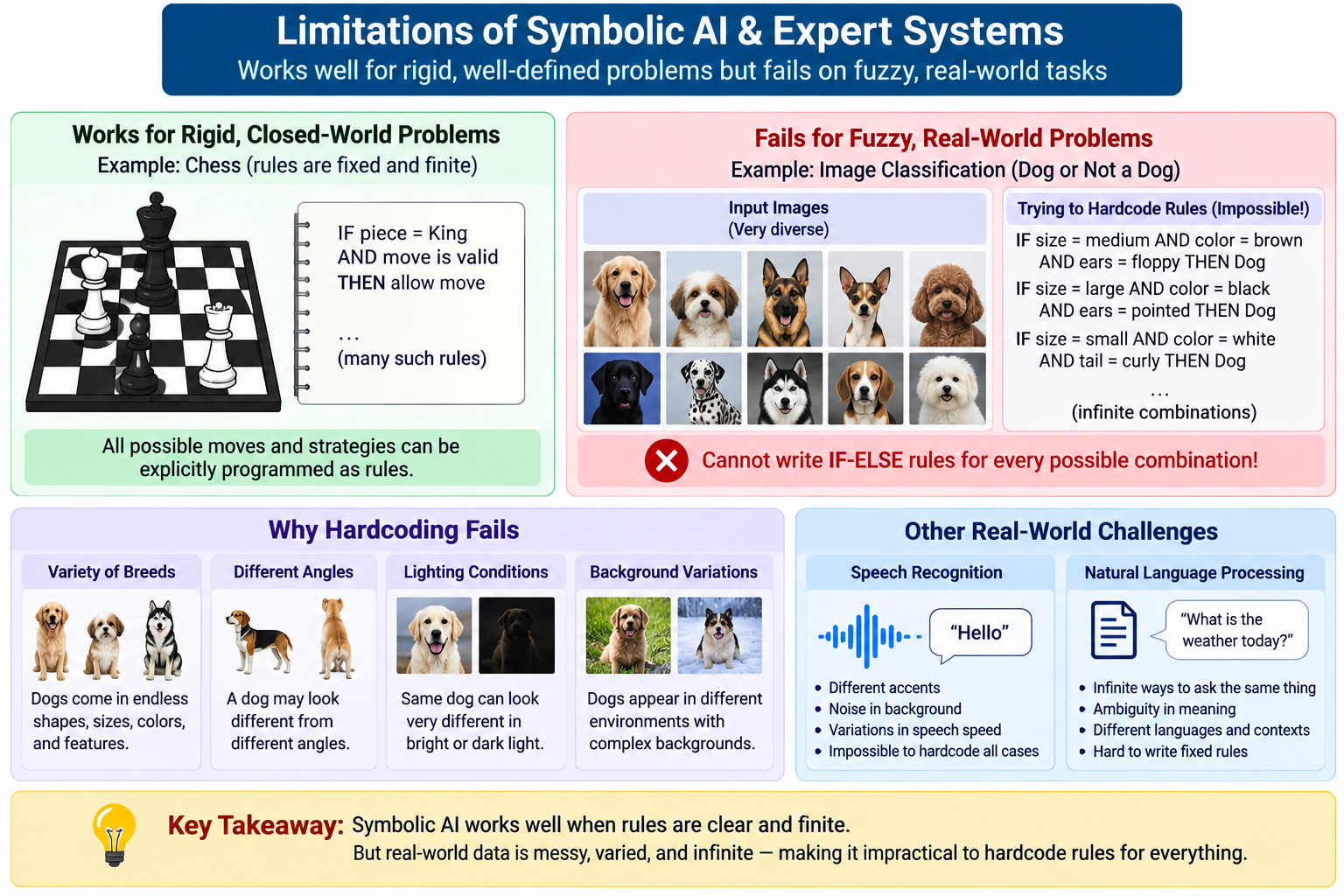
Expert systems excel at rigid, closed-world problems like chess or mathematical logic. However, they fail on fuzzy logic and unstructured real-world tasks:
- The Image Classification Problem: Identifying whether an image contains a Dog or Not a Dog.
- Why Hardcoding Fails: Dog breeds vary endlessly in size, color, ear shape, and tail length. Lighting, angles, and background variations create infinite combinations. A developer cannot manually write
IF-ELSErules for every possible visual feature of a dog. Similar limitations arise in speech recognition and natural language processing.
3. Machine Learning (ML) — The Shift to Data-Driven Rules
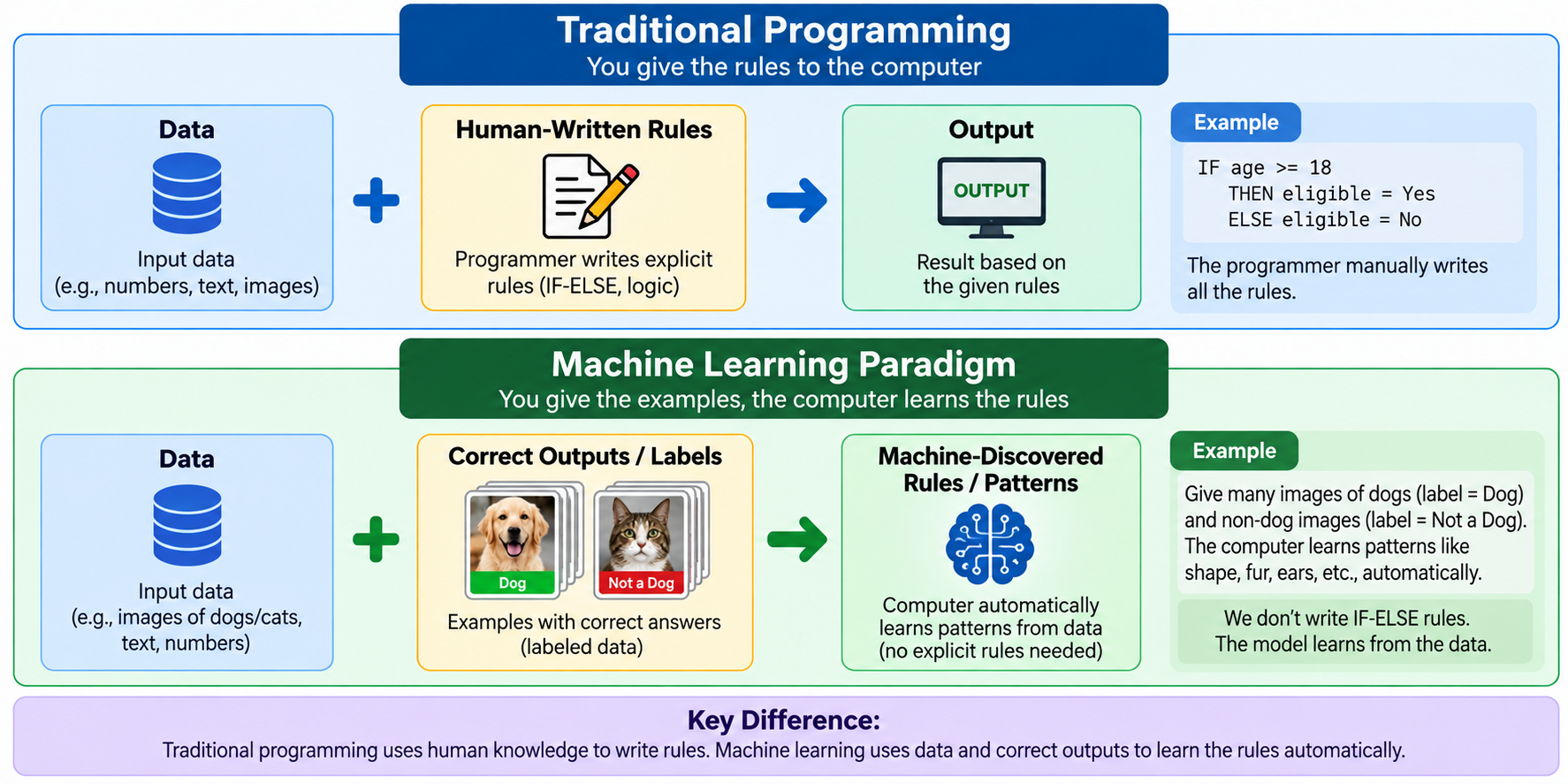
Definition: Machine Learning is a branch of computer science that applies statistical and mathematical techniques to discover underlying patterns in data without being explicitly programmed.
The Paradigm Shift
Machine Learning completely flips the traditional programming paradigm:
Example: Dog Classification via ML
Instead of writing explicit rules, you feed the ML model 10,000 images labeled "Dog" and "Not Dog". The algorithm analyzes the numerical data and automatically derives mathematical representations that distinguish dogs from non-dogs. This mirrors how human children learn from examples rather than textbook definitions.
Mathematical Foundation
Machine Learning is fundamentally applied statistics, linear algebra, and calculus packaged into practical engineering algorithms. ML gained massive industry momentum over the last 20–30 years due to the availability of large datasets and increased computing power.
4. Deep Learning (DL) — Automated Feature Extraction & Neural Networks
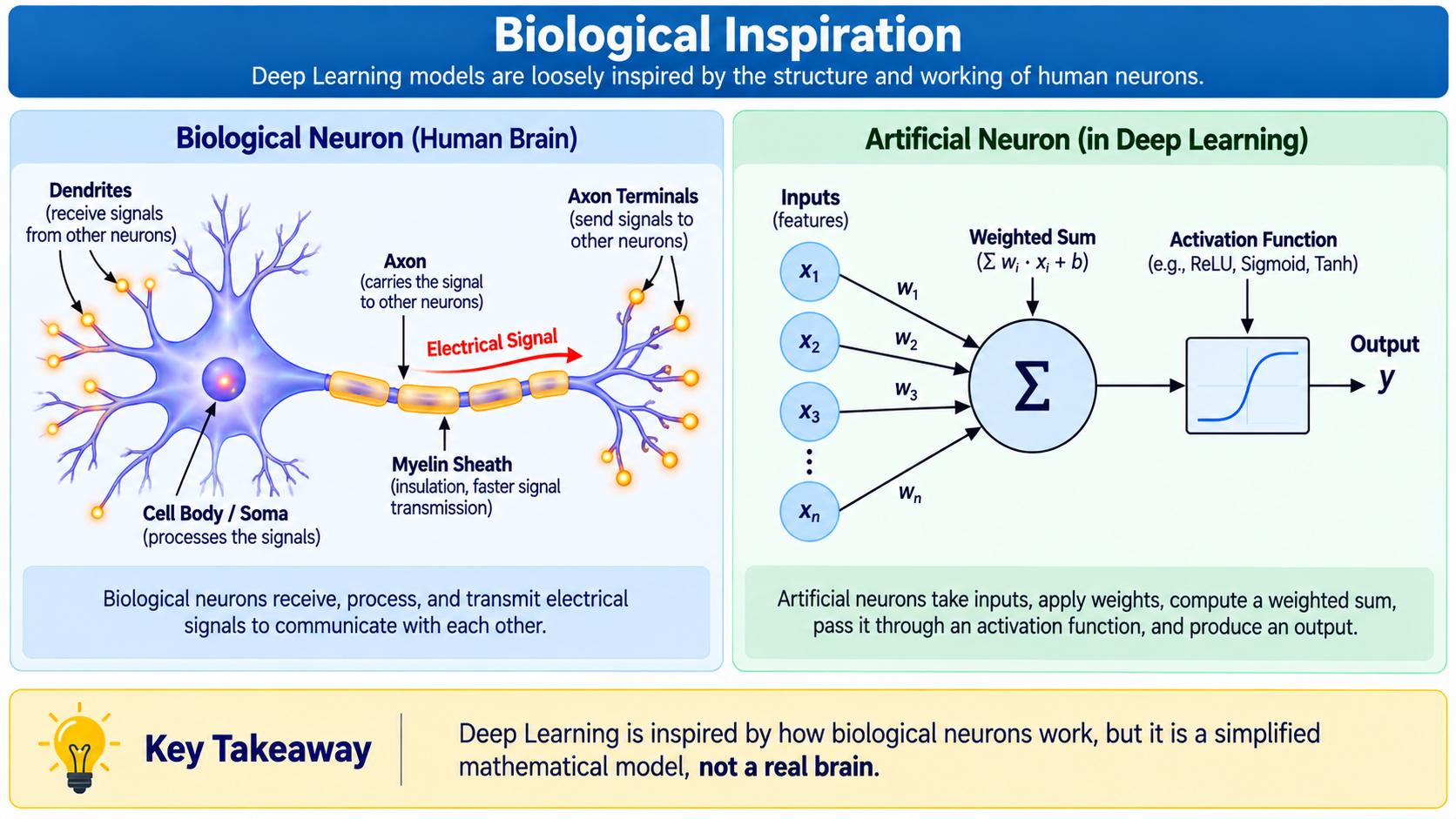
Definition: Deep Learning is a specialized subfield of Machine Learning that uses multi-layer Artificial Neural Networks (ANNs) to process complex datasets.
Deep Learning (DL) — Automated Feature Extraction & Neural Networks
Deep Learning is a specialized subfield of Machine Learning that uses multi-layer Artificial Neural Networks (ANNs) to process complex datasets.
Why Do We Need Deep Learning?
Deep Learning addresses two primary limitations of traditional Machine Learning.
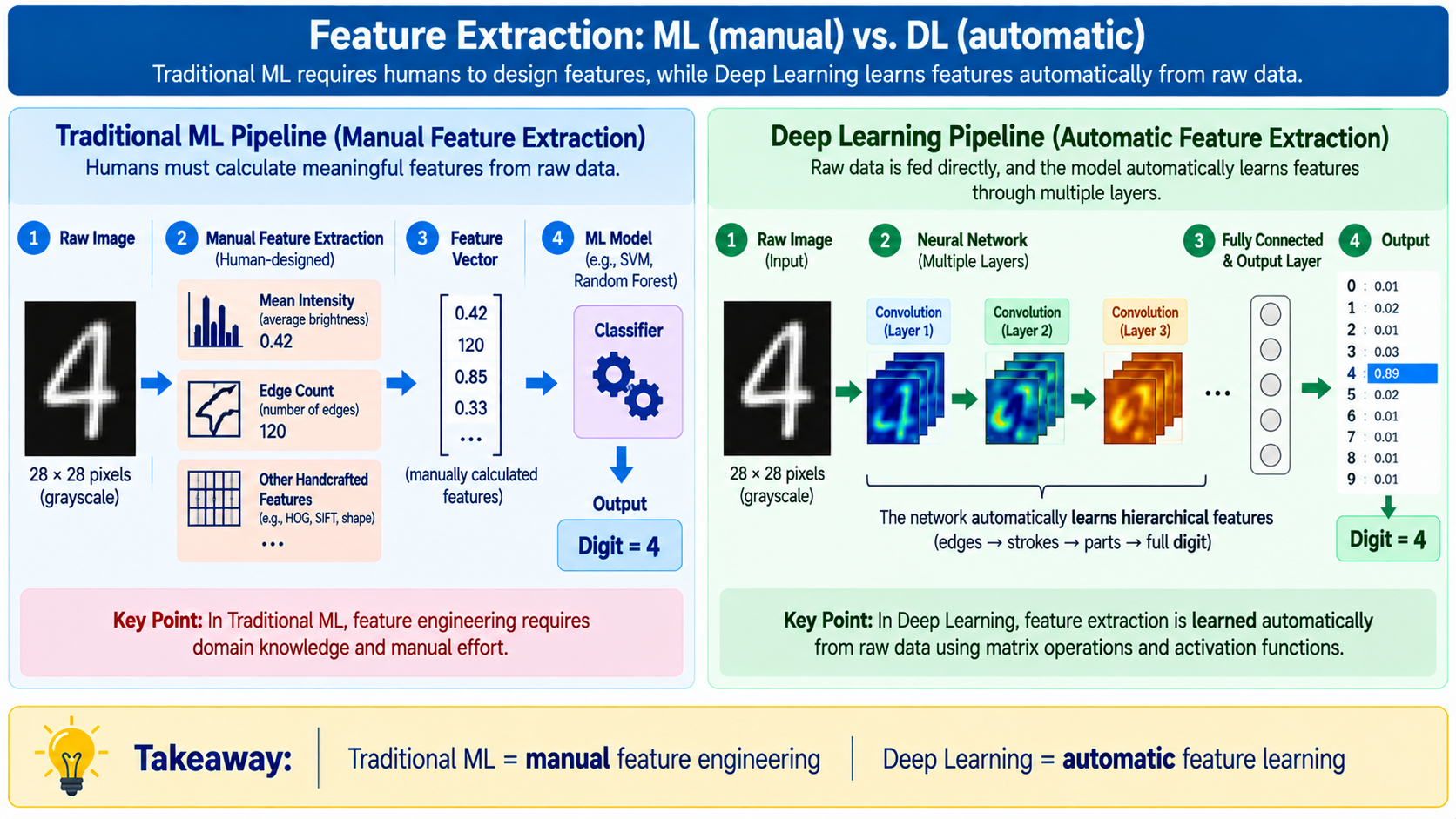
1Automated Feature Extraction
Traditional ML Limitation
- Requires domain experts to manually define features.
- e.g. CGPA, certifications (student placement).
- e.g. edge ratios, color histograms (vision).
Deep Learning Advantage
- You supply raw, unstructured data directly.
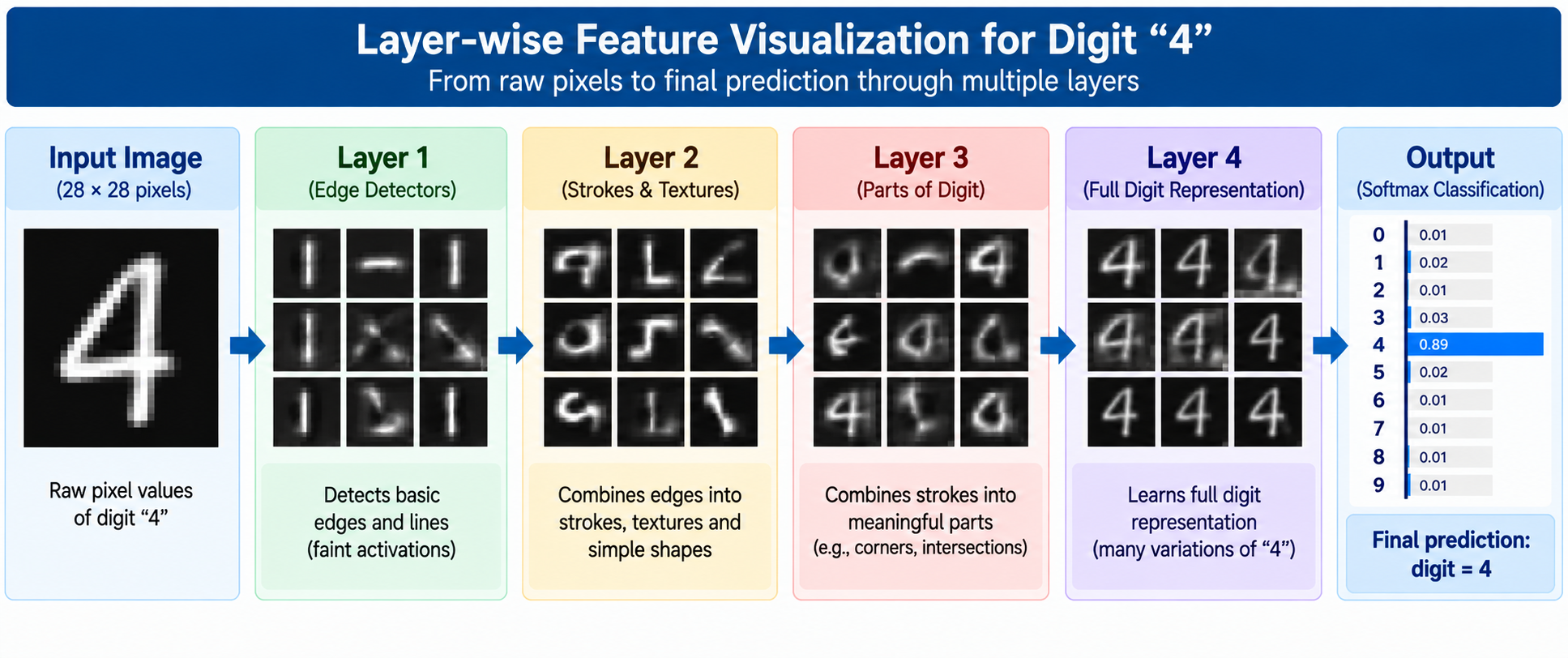
- The network automatically learns hierarchical features.
- No manual feature engineering required.
2Performance Scaling with Data
5. Side-by-Side Comparison Matrix
| Feature / Aspect | Artificial Intelligence (AI) | Machine Learning (ML) | Deep Learning (DL) |
|---|---|---|---|
| Scope | Overarching field aimed at creating intelligent machines. | Subset of AI focused on learning rules from data. | Subset of ML using multi-layer neural networks. |
| Core Approach | Rule-based systems, expert systems, and heuristics. | Statistical & mathematical pattern recognition. | Multi-layer Artificial Neural Networks (ANNs). |
| Feature Engineering | Manually crafted rules by domain experts. | Requires manual human feature extraction. | Automated feature extraction across network layers. |
| Data Requirements | Operates on formal logic/rules without big data. | Works well on small to medium structured datasets. | Requires large volumes of unstructured data. |
| Primary Data Type | Symbolic logic, structured decision trees. | Structured / Tabular data (CSVs, Databases). | Unstructured data (Images, Video, Text, Audio). |
| Hardware Dependency | Low compute requirements. | Runs efficiently on standard CPUs. | Requires heavy parallel compute (GPUs / TPUs). |
| Industry Preference | Legacy systems, rigid rule engines. | Banking, Finance, Insurance tabular models. | Computer Vision, LLMs, Speech Recognition, Autonomous Systems. |
6. Python Code Examples & Step-by-Step Breakdown
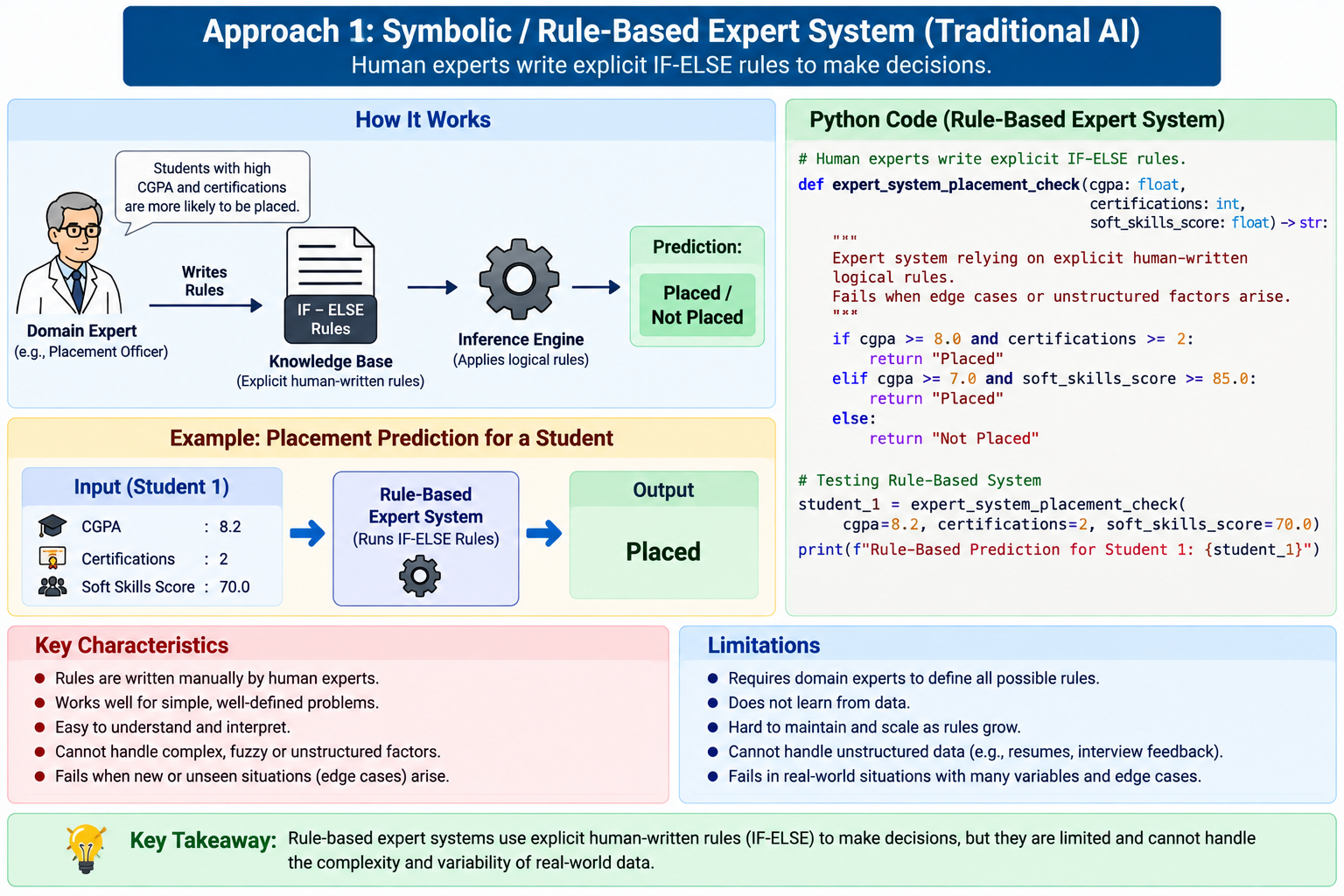
To solidify the conceptual explanations, here are two practical Python scripts illustrating the differences between Symbolic Rule-Based Logic and Data-Driven Machine Learning.
Example 1: Symbolic Rule-Based System vs. Machine Learning Classifier
Scenario: Predicting Student Job Placement Eligibility.
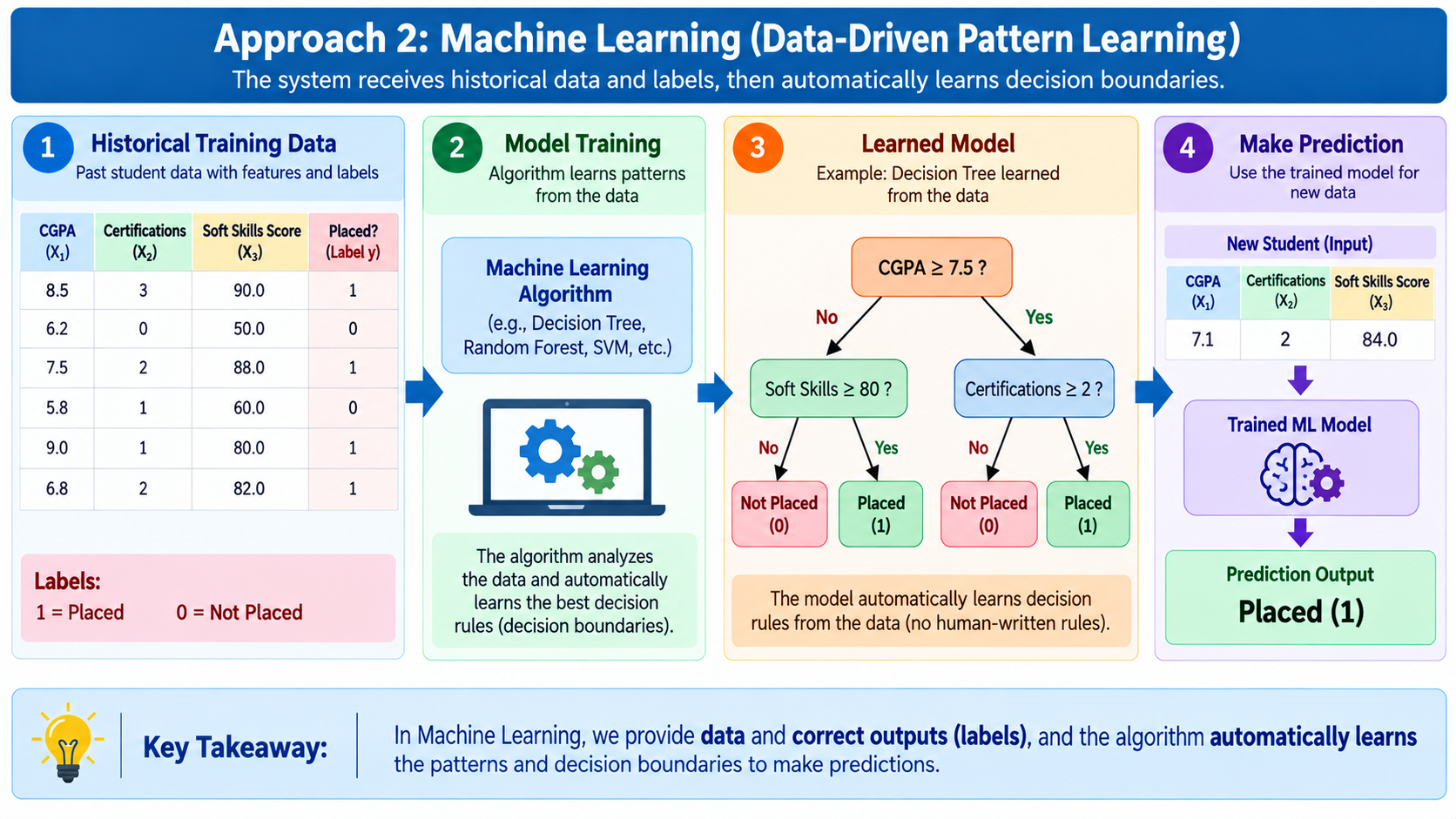
Note: They_trainarray was empty/unreadable in the source notes — filled in above with a plausible label set ([1, 0, 1, 0, 1, 1]) matching the six training rows so the example runs. Verify against the original if exact labels matter to you.
Step-by-Step Code Explanation:
- Approach 1 (Rule-Based): Demonstrates early Symbolic AI. The programmer explicitly decides thresholds (e.g.,
cgpa >= 8.0). If a student falls outside these hardcoded conditions, the system cannot adapt. - Approach 2 (Machine Learning): Uses
scikit-learn'sDecisionTreeClassifier. We pass feature matrixX_trainand target labelsy_train. The algorithm automatically determines the optimal decision boundaries from the data without manual rule coding.
Example 2: Manual Feature Engineering (ML) vs. Multi-Layer Hierarchical Representation (DL Concept)
7. Key Concepts for Quick Revision
- Concentric Hierarchy: AI is the overarching domain, ML is a subset of AI, and DL is a subset of ML (AI ⊃ ML ⊃ DL).
- Symbolic AI (Expert Systems): Rule-based systems using
IF-THENstatements, built via Human Expert → Knowledge Engineer → Knowledge Base → Inference Engine → User Interface; successful for chess and logic, but failed on unstructured fuzzy data like image/speech recognition. - Machine Learning Paradigm: Replaces manual rule-writing by accepting data and labels to discover mathematical rules automatically.
- Feature Engineering: The bottleneck in traditional ML where humans must manually extract input features.
- Automated Feature Extraction: The core breakthrough of Deep Learning where multi-layer neural networks learn feature representations directly from raw data (edges → shapes → parts → full object/output).
- Performance Scaling: ML model performance plateaus on large datasets, while DL model accuracy scales with more data and deeper network layers.
- Industry Usage: ML remains dominant for structured tabular data in banking and insurance due to lower data volumes and CPU efficiency, while DL powers Computer Vision and NLP applications.
8. Summary & Practice Questions
Summary Takeaways
- AI focuses on making machines intelligent, initially through explicit rules (Symbolic AI / Expert Systems).
- ML introduced a paradigm shift by letting algorithms learn patterns directly from data and target labels.
- DL solved ML's manual feature engineering bottleneck by using multi-layer artificial neural networks that automatically extract features from raw unstructured data.
- Choose ML for structured tabular data with moderate volume, and DL for large unstructured datasets (images, text, audio).
Practice Questions
Conceptual Questions
Scenario-Based Question
Quick Revision (1–2 min read)
- AI → ML → DL — three nested circles, each a specialization of the one before it.
- Symbolic AI (1950s): hardcoded
IF-THENrules via an expert system pipeline (expert → knowledge engineer → knowledge base → inference engine → UI). Great for chess/logic, terrible for fuzzy real-world tasks (e.g., "is this a dog?"). - ML: flips the paradigm — feed
Data + Labels, the algorithm outputs the rules, instead of a human writing the rules. Good for structured/tabular data, works on CPUs, but needs manual feature engineering and plateaus with more data. - DL: subset of ML using multi-layer neural networks; automatically learns features layer-by-layer (edges → shapes → parts → object) directly from raw data (images/text/audio); needs GPUs and lots of data, but keeps improving as data/depth grow (no plateau).
- When to use what: small/structured data & need explainability → ML; large/unstructured data (images, video, text, audio) & enough compute → DL.